

I recently had a dream in which I almost killed my father. He was cutting my mother with a large knife and while she was clearly in pain, she didn’t try to stop him. He tried to cut me too. When he dropped the knife and walked away, I picked it up and aimed it at the back of his head. But I froze. If I killed him, I knew I would feel guilt and grief. So I didn’t do anything. I woke up.
While nothing like this dream has ever happened to me in real life and my father would never do such a thing, I couldn’t stop thinking about my dream-self’s decision to freeze. I believe it had not a literal meaning but rather was my subconscious’s way of confronting me about self-abandonment.
When we have parents who abuse, shame, or manipulate us, we have two internal options to choose from. 1) Cling to our parents, and abandon ourselves, or 2) protect ourselves from harm with self-defense and recognize that what our parents are doing is bad. In the mind of a young child (0-7yo), the second option feels like death. How could these two gods assigned to care for us possibly do anything wrong? If that were true, we would feel incredibly alone and afraid. So we self-abandon. It’s the only way the world feels okay. The gods are normal; we are the bad ones.
“Everything I hate about myself you taught me.”
Gamora, Avengers: Infinity War
This quote jumped out of the screen and shook me, as did her father’s reply: “And it’s made you the fiercest woman in the galaxy.” Gamora carries such heavy anger, resentment, and bitterness towards her father. She attempts to kill him, but as he appears to be dying, she starts to weep. To survive childhood, we must convince ourselves to love our abusers. To love our abusers, we must hate and abandon ourselves.
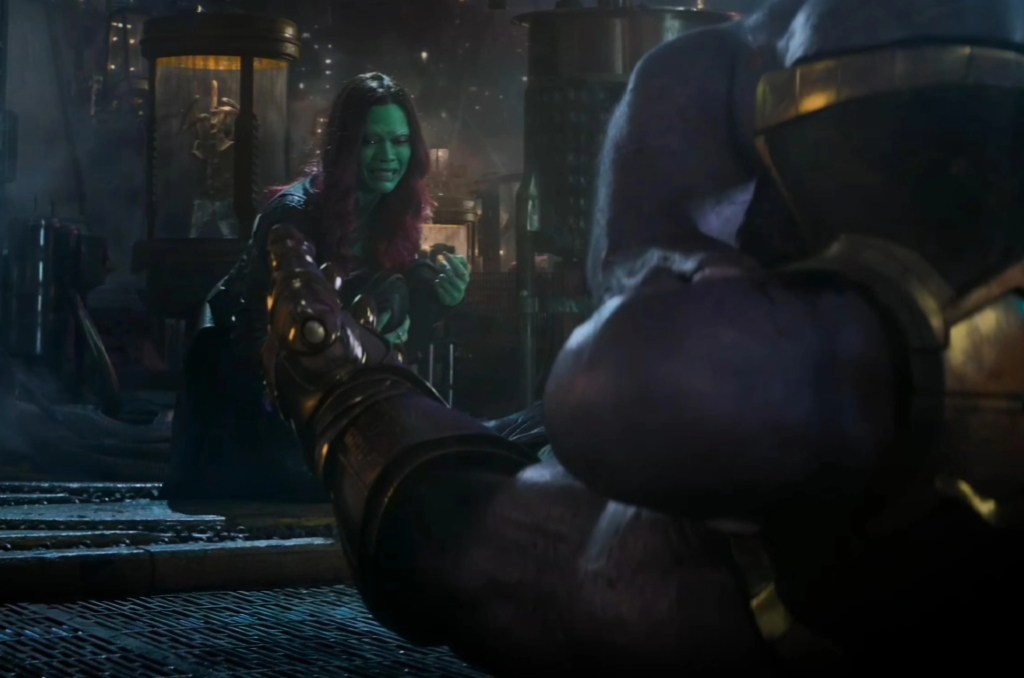
Gamora can access part of her truth, that she is angry at her father for what he did to her. But when she does, even momentarily, and acts from empowerment, the old wound resurfaces. The survival mechanism is still in place; she still feels an obligation to love and mourn for him. In her need to love him (to survive) she must abandon her need to protect herself (by killing him). In other words, protecting her father will kill her, but she chooses to do it anyways. This is self-abandonment. We abandon our needs to protect others.
self-abandonment as a protective instinct
People whose parents abandoned them often abandon themselves in caring for their children or spouse.
The pain of being abandoned is so great that instead of facing it and seeing our parents as the problem (which requires us to mourn intensely for ourselves who were abandoned), we would often rather bury the pain and abandon ourselves too. We rationalize that by giving our children/spouse what we never got, we will find peace. But this never happens. This reasoning will take you to the grave still being a caretaker and never giving yourself what you really want or need. Ever. You can’t, because to return to yourself requires that you face that original pain, no matter how long it has been. Original pain does not fade on its own. If left untreated it will become chronic, as it does in the body.
Chronic inflammation happens when the body attacks itself. It is responsible for most premature deaths in the world and is ranked by WHO as the “greatest threat to human health.” Chronic inflammation can develop from a series of untreated minor injuries (initially acute but when compiled become chronic) or a major untreated injury.
escaping our pain
If a series of minor emotional injuries (an abusive upbringing, emotional abandonment) or a major emotional injury (assault, violence, loss, war, physical abandonment) remains unprocessed and unhealed, the body will be left with chronic emotional pain (anxiety, fear, shame, grief). Until that pain is dealt with, it will linger. If it lingers long enough, it becomes so normal to the person that they do not realize how it affects every single one of their daily decisions. Suddenly their entire lives are manipulated by avoidance of chronic pain, and they remain ignorant. To be ignorant is to survive under an illusion of peace. To continue self-abandoning is to never face the original pain of abandonment. It is learning to live with a broken arm instead of getting a cast and allowing the arm to heal. To the person burdened by original pain, living with the broken arm is less scary.
using children to self-abandon
Abuse/abandonment begets self-abandonment. I’ve seen this mostly among mothers who themselves were abandoned or abused, now abandoning themselves to make their children the center of their universe. This looks like having no boundaries with your children and letting them dictate the flow of your life and your day. Teaching them to disrespect you constantly is consistent with self-abandonment. You believe that to be a good parent, you must abandon yourself and exalt your child, but it’s just the abandoned part of you trying to undo your original pain the easy way.
An extended family member of mine was abandoned by his father before he was born. His children are the center of his world, and he believes that he is taking the moral high ground by denying his needs in favor of his children’s. In reality, his children fill the gap between him and the wound of being abandoned. So long as he never abandons them, he will never have to face the pain of his own abandonment. Instead, he will comfortably continue self-abandoning with the justification that what he is doing is good; his children replace his parents as the gods he abandons himself to love.
healing means facing ourselves
As long as we can self-abandon, we can reason that we deserve to be abandoned and what happened to us didn’t really hurt. We abandon our pain and the parts of us crying out in agony. The only way to heal, to flee codependency, caretaking and self-abandonment once and for all, is to let the child still within you share his/her original pain with you. Let him finally realize how badly it hurt him to be abandoned. Let her hate and rage and mourn for the parents who failed her. Let them release it all and realize that they are still alive, that abandonment is not akin to death, and that the best thing you can do for them is to never abandon them again.
I’m still unpacking the layers to my dream. In order to avoid my original pain (guilt and grief) I self-abandoned in the moment I decided not to kill him. I also abandoned the angry part of me who wanted to defend myself and my mother; she needed me and I abandoned her to protect him. My mother also self-abandoned by defending her abuser in front of me.
While this dream is unfortunate evidence that I have more original pain to confront, it also reveals the generational nature of wounds like abandonment. My mother was a victim of extreme abuse in her childhood, and to survive, she self-abandoned. As I meet other mothers, I see them abandon themself in many unnecessary ways while parenting. I see that they are trying to compensate for the abandonment they felt by over-giving to their children. And I see that it is killing them, as it almost killed my mother, and as it killed Gamora. The only solution is to face the one person you’ve been avoiding since the pain began: you.


Leave a reply to carrie bradshaw: the queen of self-abandonmet – isabella luella newman Cancel reply