

My husband’s favorite movie is Rocky. When we first started dating, he suggested I watch it, claiming I would like it because it was romantic. When I watched it, I learned there is a big difference between what men and women each perceive as romantic. Henceforth I split romances into categories:
- Androcentric—centered around the male experience of love and romance.
- Gynocentric—centered around the woman’s experience of love and romance, typically from a modern or feminist perspective.
- Hypergamous—centered around the experience of a woman also, but is more about the politics of love than romance. Woman dates up, essentially. A more traditional narrative for women that fits in better with the androcentric ideal.
- Egalitarian—these films lack polarity and focus on both the man and woman equally, and the relationship usually fails.
the androcentric romance
In Rocky, there is an androcentric romance. Rocky “gets” the girl he’s been pursuing despite her initial disinterest in him. She has no personality and minimal character development other than from being shy and timid to confident and bold. She is flat. The only thing about her that we see is that she fully supports Rocky, which doesn’t change. But without Adrian, Rocky’s story would go on with little missing. His coach seems to have a greater impact on his character development than Adrian.
When I first watched this, I thought, what romance? A guy coerces a girl into being with him, she learns how to dress nicely, and she sticks by him through a difficult time. There is none of the drawn out “falling in love” we see in gynocentric romance arcs. There is none of the “romancing” we expect to see, no well-planned dates. No “will-you -be-mine”s. No gestures, other than the daily joke Rocky tells Adrian at her work.
But apparently men love this trope. They like to see a woman supporting a man—backing his dreams, bolstering his confidence, encouraging him to get up when he is down. It makes sense; this is one of the essential things masculinity needs. Help. It needs validation and support. Manhood is quite burdensome in a way women can only begin to understand once they accept their own femininity. Women are not supposed to take away men’s burdens. Women are supposed to support men emotionally as they struggle through and subsequently overcome obstacles. This is shallowly represented in androcentric films like Rocky.
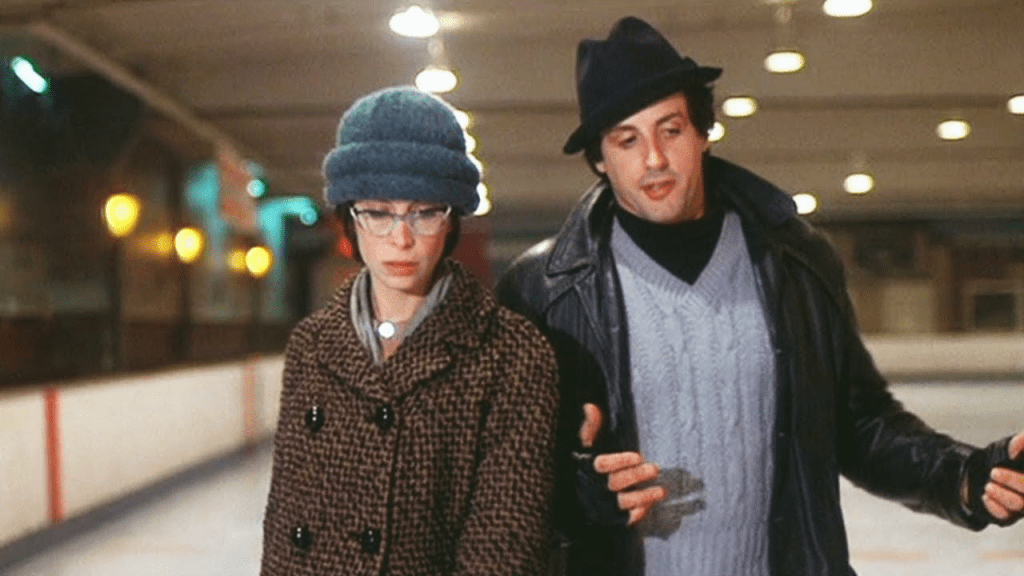
Is this romance to men–devoid of any complexity to her personhood, only demanding that she unrelentingly support him?
other romantic tropes on film
Gynocentric romances hold a totally different narrative. Man makes himself look like a fool chasing a woman. Woman is too good for him or idealized by him. Only by admitting this can he be worthy of her. She often has to make a sacrifice to be with him, and he has to “fight” for her to prove his worthiness (How to Lose a Guy in 10 Days, Knight and Day, 10 Things I Hate About You, Can’t Buy Me Love, The Notebook, The Princess Bride, A Walk to Remember, Breakfast at Tiffany’s, Notting Hill, 13 Going on 30). We ignore the obvious imbalances and they live happily ever after. These films typically have a feminist undertone. The woman chooses “love” and emotion over security, usually by picking the man who is more rugged, poor or outcast.
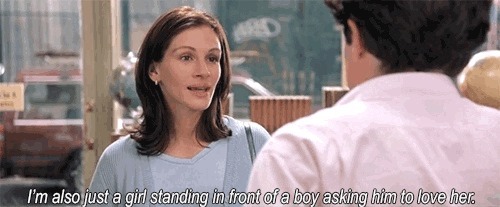
Conversely, the romance is hypergamous. This is the arc of every fairytale; a prince chooses a normal girl, giving her status in exchange for commitment. The popular jock goes with the reject, The Nanny bags the millionaire. (She’s All That, Cinderella, Ever After, Pretty Woman, Crazy Rich Asians, The Sound of Music). She falls in love but with a man who gives her the security she desires, in the form of wealth, status or safety. Suddenly she too has status and wealth, though she often faces social conflicts because of the romance.

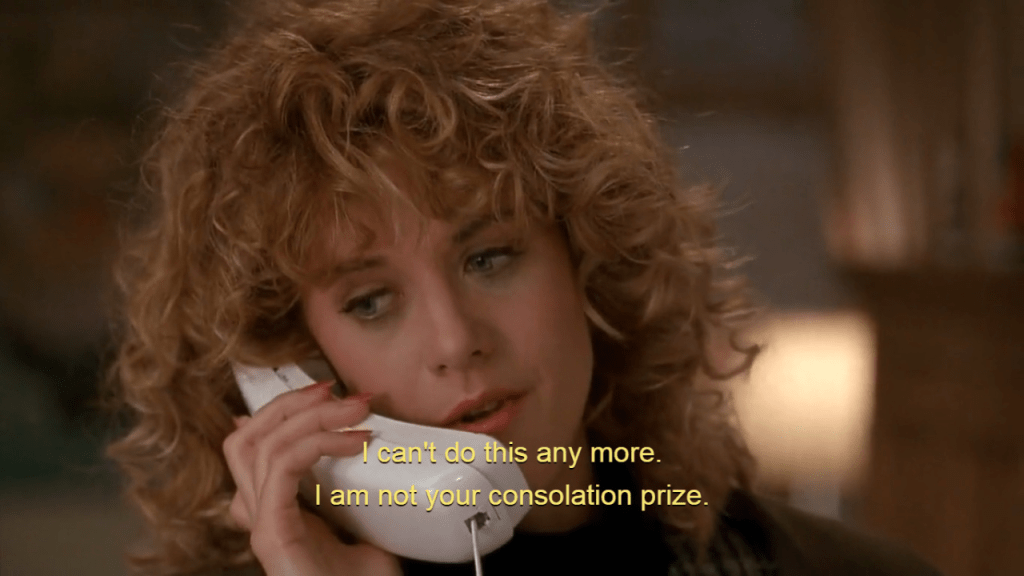
It is rarer to see a level playing field—an egalitarian romance. Even when we do it see, the man’s masculinity and the woman’s femininity are not always protected or clearly defined. These films often portray a “struggle love” where either outside forces or the characters themselves strain the relationship. The tension isn’t necessarily in the romance but the uncertainty of it (La La Land, One Day, When Harry Met Sally, Mr. And Mrs. Smith, West Side Story/Romeo and Juliet, Casablanca, Culpables, Normal People). This is the slow burn, enemies to lovers, friends to lovers, forbidden romance, common interest kind of love story. It usually doesn’t end well. If there is a “happily ever after” ending, it takes a bumpy road to get there.
In some cases the female protagonist must choose between the two tropes in the film/series:
- Materialists: hypergamy (super rich, respectable guy) vs. feminism/gynocentricism (poor, broke guy who “loves her”). She choses the latter.
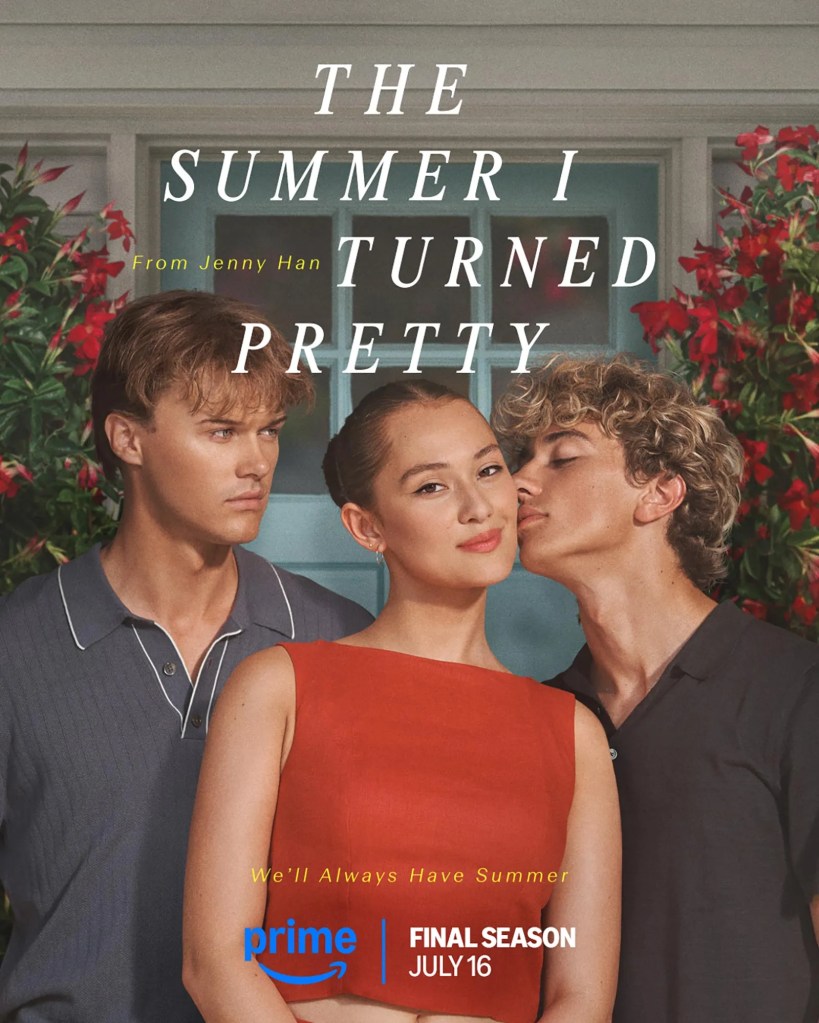
- The Summer I Turned Pretty: hypergamy (smart, mature older brother) vs. gynocentricism (dumb, immature younger brother who “loves her”). She chooses the former.

Do these tropes signal what women want out of romance? Either 1) to be worshipped by men, 2) to be saved, spoiled and taken care of by men or 3) to be equal to and as respected as men?
how male-centered romances use women
The reason I didn’t see the Rocky romance as significant is it falls into the category of Ethan Hunt’s girl or the “Bond girl” trope. Even though she is the “dream girl,” idyllic and perfect, she is written to be a disposable character. She is completely replaceable and is usually replaced if the film is part of a series. She exists only to be the manifestation of his idealization, to meet his temporary needs, in the androcentric romance (Rocky, Mission Impossible, Back to the Future, Top Gun, Elvis, James Bond).
It is rare to see an androcentric film with a supporting female who the story would be nothing without (Inception, 500 Days of Summer). In gynocentric films, the supporting men are integral to her story and character development, even if they don’t end up together (I Feel Pretty, Clueless, Priscilla, Lady Bird, Little Women, Legally Blonde, Dirty Dancing). Men are not disposable in these films; they are important parts of the female lead’s character progression. But in films with male leads, women are more often disposable as supporting characters.
If we apply this outside of film, the idea is that men play a central role in the lives of women, but to men, women are merely foils. Even when women claim to be self-centered, their success is largely dependent on men (by trying to be equal to them or independent of them). In other words, most women’s models of personhood are based on their relationship to or distance from men. For men, women are just there to make life better, to make him feel bigger.

what’d you think?